Qyralvenox
Drift Map
Drift Map
Couldn't load pickup availability
1. Problem Statement
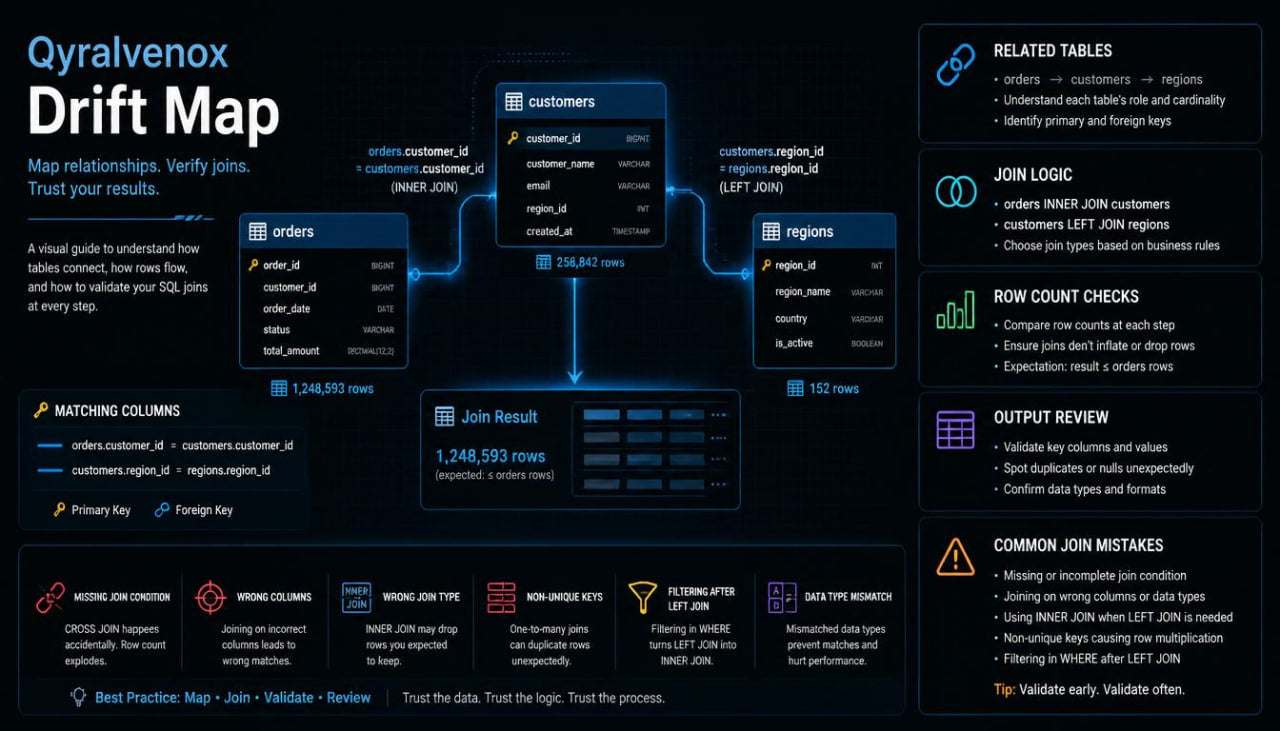
Many learners feel comfortable with simple queries until the data is split across several tables. At that point, SQL can start to feel less like writing statements and more like solving a puzzle without a map. It may be unclear which column connects one table to another, why some rows disappear, or why a query returns repeated results. Joins can also become difficult when learners memorize syntax without understanding the data relationship underneath. Drift Map addresses this stage by making table connections, join choices, and result reading more structured.
2. Solution
Drift Map teaches learners how to think through related tables before writing the query itself. The course explains common table relationships, shows how keys connect records, and demonstrates how different join types change the result. Each module uses practical examples to compare expected output with actual output. Learners study why query planning matters, especially when several tables are involved. The course supports a more careful SQL workflow, from reading table structure to checking whether the final result matches the question being asked.
3. What’s Inside
Drift Map includes detailed modules on multi-table SQL work. The first section introduces table relationships and explains how data can be divided across separate tables while still describing one shared topic. Learners review identifiers, matching columns, and the difference between storing data cleanly and retrieving it clearly. The next module covers inner joins through practical examples, showing how matching records appear in the final result.
A separate module explores outer join patterns and explains why unmatched records may still matter in certain questions. Learners compare outputs side by side to see how join choices affect row counts and missing values. Another section focuses on table aliases, column naming, and clean query formatting, especially when several tables contain similar column names. The course also includes exercises where learners inspect a question, identify the needed tables, choose a join approach, and review the returned rows.
Later materials introduce common join mistakes, such as joining on the wrong column, creating duplicate rows, or filtering too early. Review tasks help learners slow down and verify their query logic before moving forward. Drift Map also includes a compact relationship glossary and scenario-based practice prompts for learners who want repeated exposure to connected-data tasks.
4. Who Is This For?
Drift Map is for learners who know basic filtering, sorting, and grouping, and now want to understand how SQL works across related tables. It fits learners who prefer examples that explain why a query returns a certain result. It is also useful for people who have seen joins before but want a more organized way to study them.
5. What You’ll Learn
- How related tables are structured
- How matching columns connect records
- How inner joins shape query results
- How outer join patterns handle unmatched rows
- How aliases make multi-table queries clearer
- How to avoid common join mistakes
- How to read row counts and duplicated records
- How to plan a query before writing it
- How to check whether a joined result answers the original question
6. Refund Note
Drift Map includes a 30-day refund window according to the checkout terms shown at purchase. Learners may review the course materials during that period and decide whether the format fits their current study needs.
Self-paced learning overview
- 📁 Digital file available after purchase
- 📌 Long-term availability
- 🔐 Secure checkout
- 🗓️ Content updated in 2026
Do I need prior SQL knowledge?
Do I need prior SQL knowledge?
No. Qyralvenox courses are written for learners who want structured SQL study from the ground up, with clear explanations and practical tasks.
What format are the materials in?
What format are the materials in?
Each plan includes written lessons, guided modules, examples, and practice tasks arranged by topic.
Can I choose a higher plan later?
Can I choose a higher plan later?
Yes. The plans are arranged in growing depth, so learners can begin with a smaller set and later move into broader collections.
Share