Qyralvenox
Anchor Library
Anchor Library
Couldn't load pickup availability
1. Problem Statement
As SQL topics grow, learners often need more than isolated explanations. They may understand filters, joins, and grouping separately, yet still struggle to decide which tool fits a specific data question. Notes can become scattered, and returning to earlier ideas may take more time than the task itself. Larger SQL study also requires repeated review, because small syntax choices can change the meaning of a query. Anchor Library addresses this by giving learners a structured place to connect core SQL ideas with reusable examples.
2. Solution
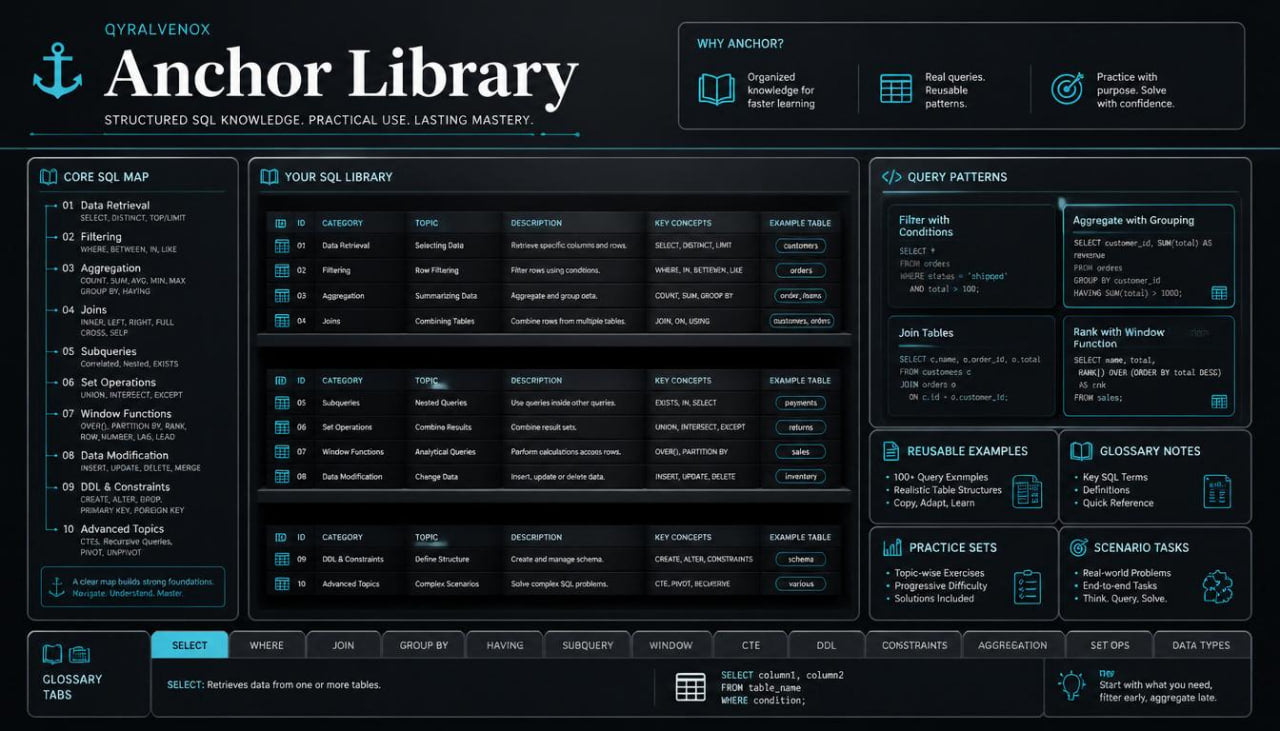
Anchor Library presents SQL as a practical reference journey, not only as a sequence of topics. The course combines guided modules with organized materials that learners can return to while practicing. Each section links a concept with examples, review notes, and tasks that reinforce how the idea works in real query writing. Learners study how to choose between filters, joins, grouped summaries, and layered logic depending on the question. The course is intended for learners who want a deeper study base with steady review points.
3. What’s Inside
Anchor Library begins with a review map of core SQL concepts, including table structure, column selection, row filtering, ordering, grouping, and joined data. This opening module gives learners a shared reference point before moving into larger tasks. The next section focuses on query reading, showing how to examine a statement line by line and understand the role of each part.
A central part of the course is the query reference library. It includes reusable patterns for selection, filtering, grouping, joining, comparison tasks, and report-style output. Each pattern is paired with an explanation, a sample task, and notes about when the pattern may be useful. Learners can study these examples as models while building their own statements.
The course also includes modules on choosing the right query shape. Learners compare similar tasks and see why one may call for a join, while another may call for grouped output or a subquery. This section helps reduce guesswork by connecting plain-language questions with SQL structures.
Practice materials include themed exercises, review prompts, and task sets that build from shorter statements to multi-part queries. Learners also receive glossary-style notes for recurring terms, including aliases, conditions, aggregate functions, related tables, derived columns, and result sets. The closing module brings these pieces together through scenario-based tasks where learners read a question, plan the query, write the statement, and review the output.
4. Who Is This For?
Anchor Library is for learners who want a richer SQL study base after working with fundamentals, joins, and query structure. It suits people who like having organized materials they can revisit while practicing. It is also useful for learners who want to compare query patterns and understand when each one fits a data task.
5. What You’ll Learn
- How to connect SQL concepts across several topic areas
- How to read longer queries with better structure
- How to choose between filters, joins, grouping, and subqueries
- How reusable query patterns support steady practice
- How to turn plain-language data questions into query plans
- How to review output and spot mismatches
- How to organize SQL notes for continued study
- How to work through scenario-based query tasks
6. Refund Note
Anchor Library includes a 30-day refund window according to the checkout terms shown at purchase. Learners may review the course materials during that period and decide whether the format fits their study needs.
Self-paced learning overview
- 📁 Digital file available after purchase
- 📌 Long-term availability
- 🔐 Secure checkout
- 🗓️ Content updated in 2026
Do I need prior SQL knowledge?
Do I need prior SQL knowledge?
No. Qyralvenox courses are written for learners who want structured SQL study from the ground up, with clear explanations and practical tasks.
What format are the materials in?
What format are the materials in?
Each plan includes written lessons, guided modules, examples, and practice tasks arranged by topic.
Can I choose a higher plan later?
Can I choose a higher plan later?
Yes. The plans are arranged in growing depth, so learners can begin with a smaller set and later move into broader collections.
Share